
Article
Valuing your business: a guide for medium-sized business owners
What drives business value, what buyers actually pay for and the factors you can strengthen before a transaction is on the table.

If you own a Canadian business with $20 million to $1 billion in revenue, the last 12 months have probably felt like decision-making in fog. Input costs are harder to predict. Customers are slower to commit. Capital planning that used to work on a three-year horizon now feels like a quarterly exercise. There have been very few things you could be certain of.
But there is one.
On July 1, Canada, the United States and Mexico are scheduled to hold the first mandatory joint review of the Canada-United States-Mexico Agreement (CUSMA). If all three parties agree, the trade pact will extend to 2042. If any party declines, the agreement stays in force, but shifts into annual reviews through its 2036 expiry — creating a persistent overhang of uncertainty. A clean extension is no longer something business owners should assume. The U.S. Trade Representative indicated in early April that negotiations are unlikely to resolve all outstanding issues by the deadline.1
This is not just a trade-policy story. It is a pricing story, a financing story and an optionality story.
Buyers do not punish uncertainty. They punish businesses that have no answer to it.
Canadian mid-market valuations remain disciplined for well-run companies. What has changed is how buyers test resilience.
It shows up in diligence — harder scrutiny of customer concentration, supplier dependency and any cost or revenue line that rests on one trade assumption. It shows up in deal structure — more earnouts, vendor take-backs and milestone-based payments — as buyers bridge the gap between stable-environment value and uncertain-environment value. And it shows up in selectivity — capital is still available, but it flows toward businesses that look resilient under multiple scenarios.
The difference between a resilient business and a vulnerable one is built — deliberately, over 12 to 24 months. Five steps matter most right now:
1. Stress-test your U.S. exposure. Map every revenue line and supply chain node that touches the border. Quantify how a five to 10 per cent increase in cross-border friction would affect gross margins.
2. Build a value story that does not depend on one trade assumption. Diversified revenue, domestic demand floors and pricing power reduce structural vulnerability.
3. Get a current baseline valuation. The assumptions from 2022 or 2023 may not hold. Understanding your current fair market value gives you optionality whether you transact this year or in five.
4. Strengthen what buyers pay premiums for. Management depth, low key-person risk, recurring revenue, clean financials and operational maturity matter even more in uncertain markets.
5. Start the diagnostic work before timing is forced on you. The most common regret in M&A is not starting too early. It is starting 18 months too late.
Roughly 76% of Canadian businesses are expected to change ownership in the next decade2. For most owners, the majority of their personal net worth is concentrated in a single illiquid asset. The CUSMA review will not determine the fate of every company. But it will shape the negotiating environment for Canadian transactions through at least the end of the decade.
The owners who emerge strongest will not be the ones who guessed the political outcome correctly. They will be the ones who used uncertainty as a catalyst — to clean up their financials, reduce their dependencies and position their businesses as the kind of assets that attract premium capital in any environment.
July 1 is coming. The question is not whether the review will affect your business. The question is whether your business will be ready.
For more insights and advice on growing or selling your business.
In the screened Capital IQ closed-deals dataset used for this newsletter, Q1 2026 recorded 33 Canadian private-company M&A closings and 38 private placements, compared with 54 M&A closings and 40 private placements in Q4 2025. M&A closings slowed materially, while private placements held comparatively steadier.
The broader picture is consistent with current Canadian market outlooks: dealmaking remains active, but buyers are more measured, diligence is deeper and underwriting is more selective. Capital is still available for strong opportunities even as traditional M&A activity has become more cautious.
For business owners, the implication is not that the market is closed. It is that preparedness matters more than it did 12 months ago — particularly clean financials, lower concentration risk, management depth and a credible growth narrative. The businesses attracting competitive interest in this environment are the ones that can answer tougher buyer questions with confidence.
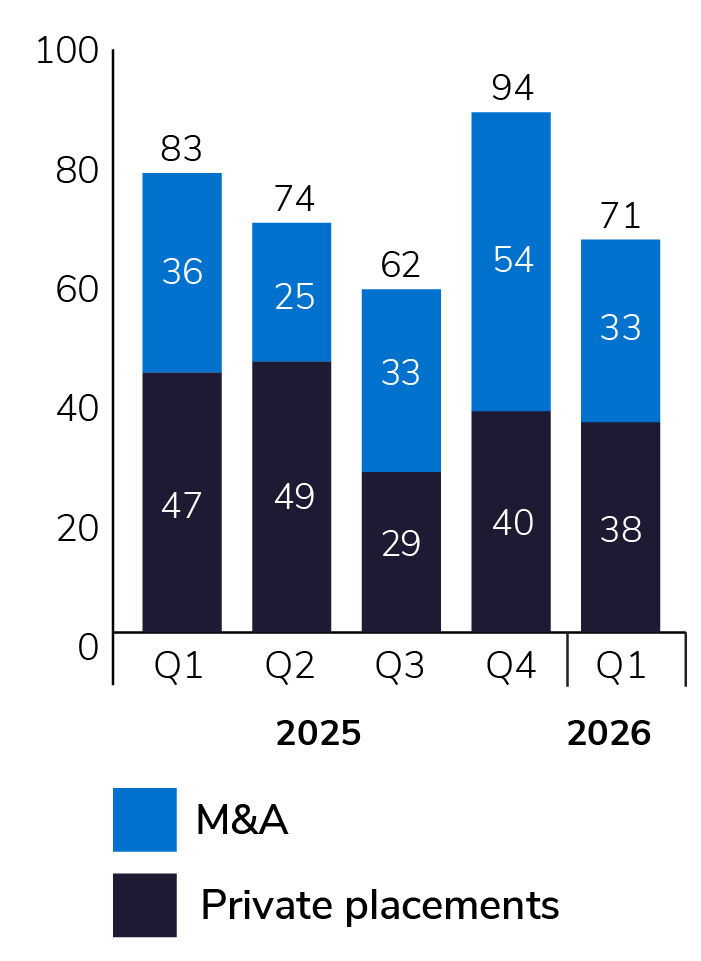
Transaction data sourced from S&P Capital IQ. M&A and private placement counts reflect screened Canadian private-company closed transactions above C$10 million.
The valuation trend charts in this newsletter track median disclosed EV/sales and EV/EBITDA multiples across North American private-company M&A transactions in three transaction-value brackets: C$10–50 million, C$50–100 million and C$100–500 million. Across the historical quarterly chart data, larger transaction brackets have generally screened at higher multiples than smaller ones.
No single quarter should be treated as a rule. But the directional pattern is consistent: scale is often associated with stronger pricing. That does not mean size alone creates value. It does mean that the work required to build scale often overlaps with the qualities buyers reward most.
For business owners, the implication is practical. The same work that builds scale and quality — stronger management depth, cleaner earnings, recurring revenue and broader buyer relevance — also improves how a business is likely to be valued when the time comes. Scale does not guarantee a premium. But it consistently changes the conversation.
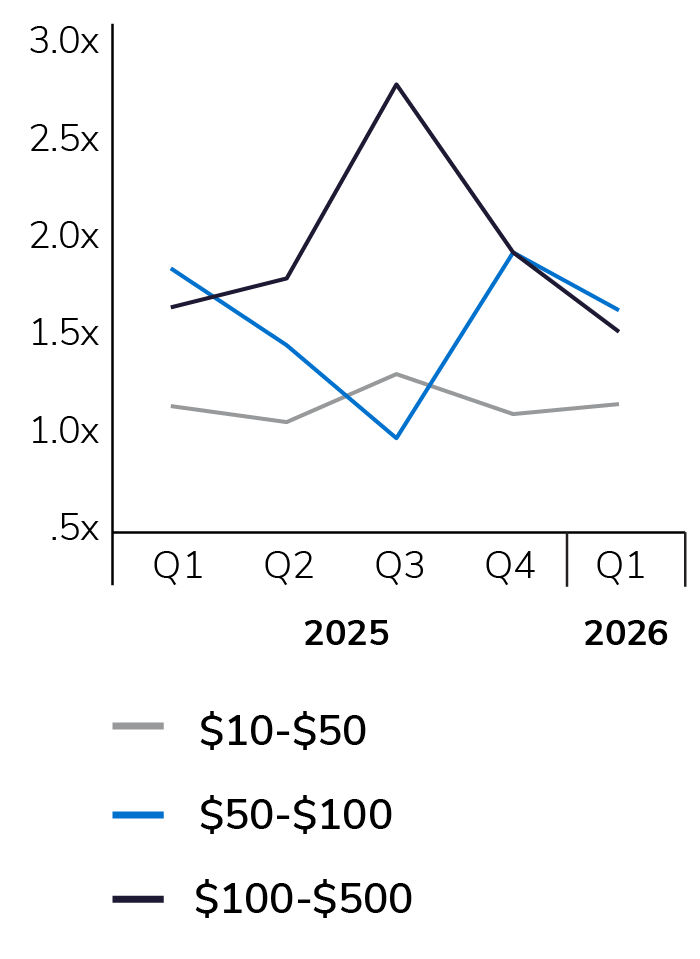
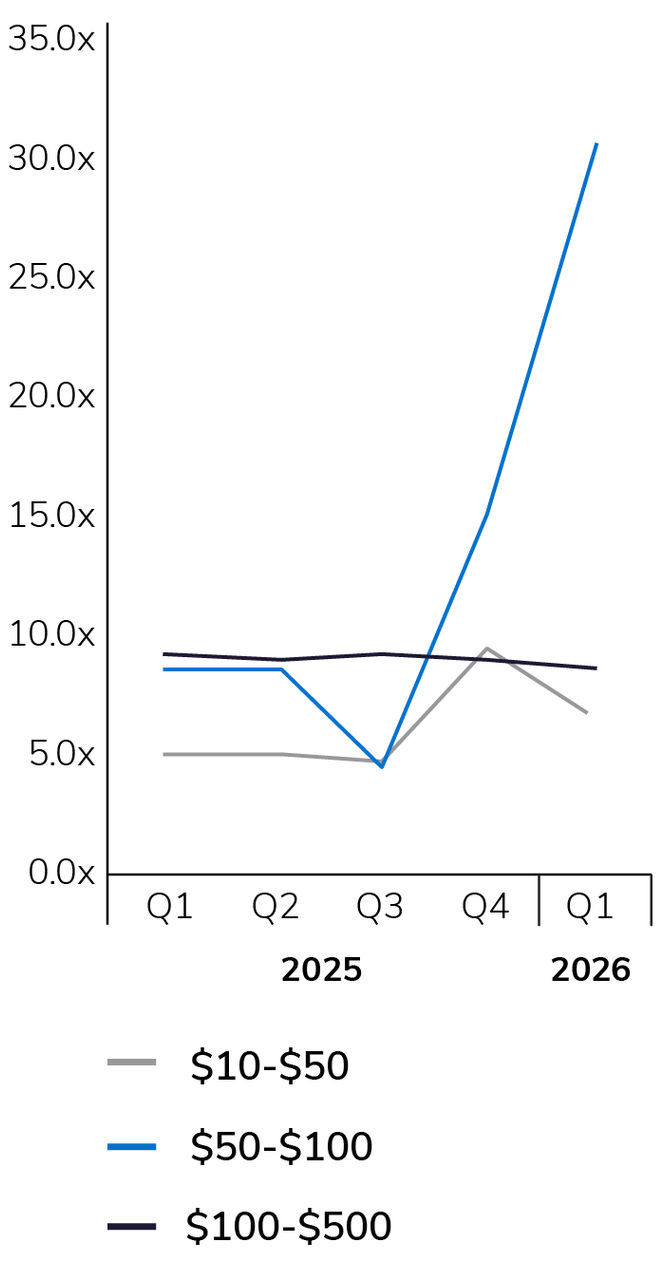
Transaction data sourced from S&P Capital IQ. M&A and private placement counts reflect screened Canadian private-company closed transactions above C$10 million. Valuation multiples use a broader North American screen to ensure sufficient sample sizes for median calculations.
IG Private Company Advisory provides strategic and transaction advisory services for transactions of $20 million to $1 billion in revenue. Discover how we can help unlock your company's potential.
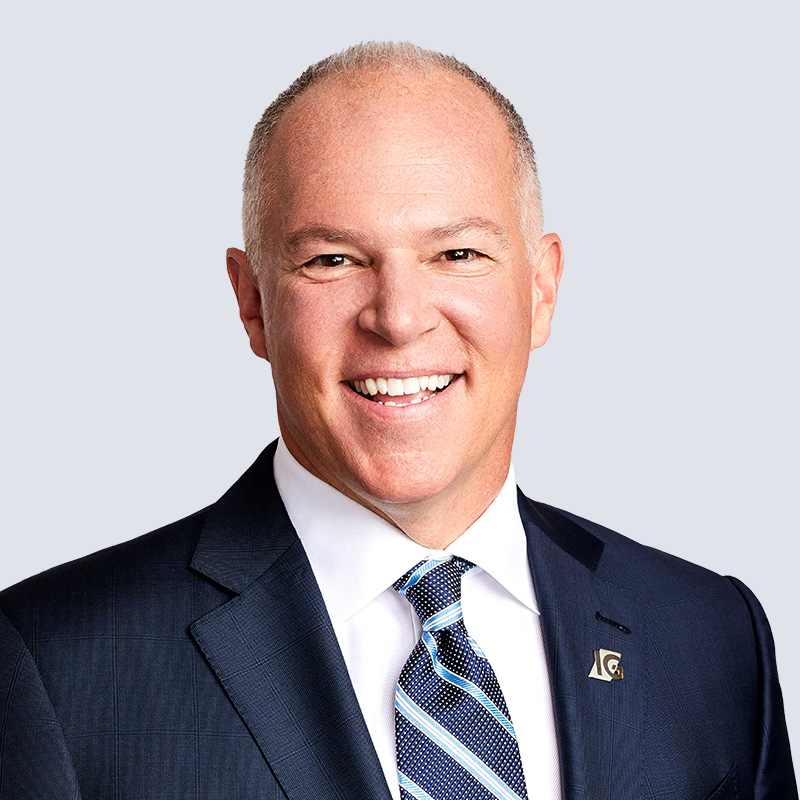
David Turnbull — Head of IG Private Company Advisory — leads a team with decades of experience across many industries. His team has access to an extensive global network of strategic and financial business buyers and capital providers. This helps business owners navigate growth, capital decisions and transactions with institutional-quality M&A, corporate finance and strategic advice.
1 The Canadian Press, reporting on USTR Jamieson Greer’s remarks at the Hudson Institute, April 7, 2026.
2 Canadian Federation of Independent Business, Succession Tsunami: Preparing for a decade of small business transitions in Canada, January 2023.
Trademarks, including IG Wealth Management and IG Private Wealth Management, are owned by IGM Financial Inc. and licensed to subsidiary corporations. This commentary is published by IG Wealth Management. It represents the views of our Portfolio Managers, and is provided as a general source of information. It is not intended to provide investment advice or as an endorsement of any investment. Some of the securities mentioned may be owned by IG Wealth Management or its mutual funds, or by portfolios managed by our external advisors. Every effort has been made to ensure that the material contained in the commentary is accurate at the time of publication, however, IG Wealth Management cannot guarantee the accuracy or the completeness of such material and accepts no responsibility for any loss arising from any use of or reliance on the information contained herein. Investment products and services are offered through IG Wealth Management Inc. (in Québec, a firm in financial planning), a member of the Canadian Investor Protection Fund. This commentary may contain forward-looking information which reflects our or third party current expectations or forecasts of future events. Forward-looking information is inherently subject to, among other things, risks, uncertainties and assumptions that could cause actual results to differ materially from those expressed herein. These risks uncertainties and assumptions include, without limitation, general economic, political and market factors, interest and foreign exchange rates, the volatility of equity and capital markets, business competition, technological change, changes in government regulations, changes in tax laws, unexpected judicial or regulatory proceedings and catastrophic events. Please consider these and other factors carefully and not place undue reliance on forward-looking information.

